
Global Workforce Governance & Compliance Reporting Hub
About the Client
A large BFSI enterprise with a workforce exceeding 50,000 employees operates across multiple regions, managing complex, highly regulated financial operations. The organisation supports a distributed field workforce with multi-layered reporting structures, regional leadership, and central governance teams.
As part of its digital transformation strategy, the organisation aimed to reduce operational expenditure, strengthen governance and auditability, and eliminate dependency on fragmented legacy tools that constrained scale and decision-making.
The Challenge
The organisation relied on hundreds of Excel files, manual assignments, and written logs to manage workforce hierarchy, approvals, transfers, and performance tracking. These processes had evolved organically over more than a decade and were deeply embedded in day-to-day operations.
This resulted in:
Limited visibility into workforce structure and approvals
High operational risk due to manual updates and inconsistencies
Slow onboarding, offboarding, and territory realignment
Delayed performance reporting and decision-making
Weak auditability for hierarchy changes in a regulated BFSI environment
Managing a 10+ level hierarchy with frequent temporary allocations and transfers became increasingly unmanageable as the organisation scaled.
The client required a single source of truth that could enforce role-based access, preserve data integrity, support approvals and audit trails, and scale without increasing operational overhead.
Engagement Model
Our engagement began as a fixed-scope, six-month delivery focused on solving the organisation’s most critical hierarchy and governance challenges. A dedicated cross-functional team of seven was assigned, comprising backend and frontend engineers, QA, and project management.
Client operations managers who previously maintained Excel-based processes worked closely with our business analysts and delivery leads to translate legacy workflows into a governed digital system.
Following successful delivery and adoption, the engagement evolved into a long-term partnership, with ongoing enhancements and support driven by business priorities.
The Solution
We designed and delivered an enterprise-grade hierarchy management and operational governance platform tailored for BFSI regulatory and audit requirements.
The platform replaced years of manual processes with a secure, access-controlled system that centralised workforce hierarchy, approvals, transfers, and performance visibility into a single, authoritative platform.
All workflows were designed with data consistency, auditability, and role-based governance as first-class requirements.
Architecture Overview
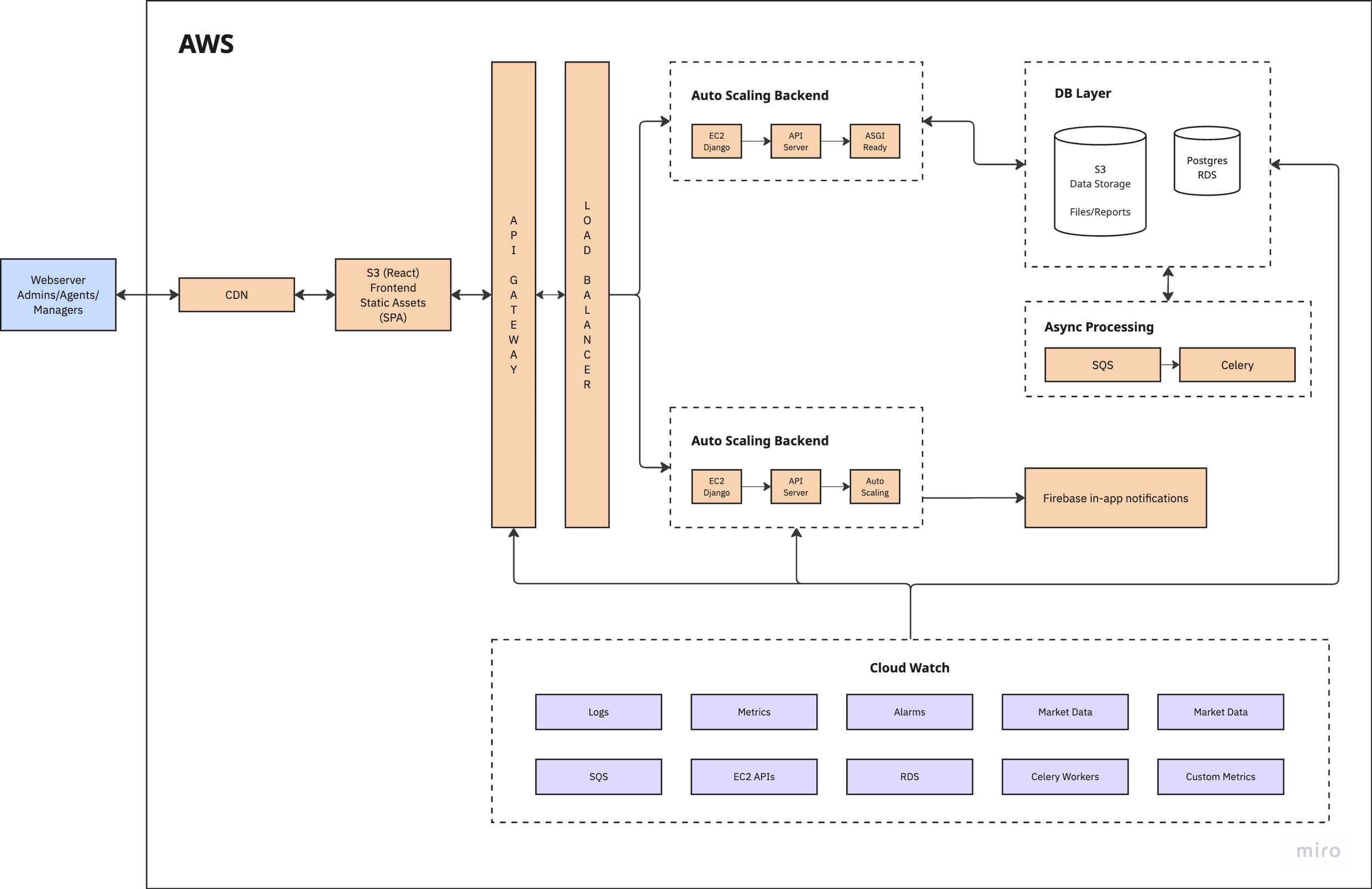
The system was built using a scalable, modular web architecture:
React-based SPA hosted on Amazon S3 and delivered via CDN
Django backend services deployed on AWS EC2 with auto-scaling
PostgreSQL as the primary data store with transactional consistency
Asynchronous processing using Celery and SQS for imports, approvals, and validations
Secure Excel ingestion and processing pipelines
Centralised logging and monitoring via Amazon CloudWatch
The architecture prioritised data consistency over raw speed, ensuring correctness in hierarchy and approvals even under concurrent usage.
The Solution
1. Hierarchy and Workflow Management
We implemented a dynamic, multi-level hierarchy engine capable of modelling complex reporting structures across field agents, supervisors, regional heads, and central teams.
Key capabilities:
Accurate representation of 10+ hierarchy levels
Temporary and permanent reallocation of staff reflected live in the hierarchy
Automated approval workflows for transfers and role changes
Clickable hierarchy nodes enabling context-aware actions
Atomic updates to prevent broken or inconsistent hierarchies
This eliminated multi-day manual updates and ensured structural changes were instantly reflected across the organisation.
2. Role-Based Portals and Access Governance
The platform enforced strict role-based access control at every layer.
Dedicated portal experiences for administrators, managers, supervisors, and field agents
Backend-enforced visibility rules ensuring users could only view data within their hierarchy scope
Granular permissions for viewing, editing, approving, and reassigning entities
Prevention of privilege escalation through server-side permission and hierarchy validation
This replaced informal data access via shared files and emails with governed, auditable access.
3. Integrated Performance and Operational Tracking
Previously fragmented HR and sales data was unified into a consistent operational model.
The system automated:
Onboarding and offboarding workflows
Territory and role changes
Performance tracking aligned to organisational hierarchy
Delegation of responsibilities during workforce shortages
Leadership gained immediate visibility into operational performance without manual reconciliation.
4. Real-Time Dashboards and Analytics
The platform introduced live dashboards and analytics for supervisors, regional heads, and central teams.
Real-time workforce availability and performance metrics
Hierarchy-aware analytics ensuring accurate roll-ups
Lazy-loaded visual hierarchy rendering for fast navigation at scale
This reduced decision latency and enabled proactive operational management.
5. Compliance, Auditability, and Governance
Given BFSI regulatory requirements, every critical action was fully traceable.
The platform implemented:
Immutable audit logs for role changes, approvals, transfers, edits, and access activity
Short-term hot storage with archival for audit retention
Encrypted storage of sensitive personal and employment data
GDPR-aligned access control and data minimisation principles
This significantly simplified internal audits and strengthened governance confidence.
Security and Operations
Security and operational discipline were integral to delivery:
JWT-based authentication with encrypted request/response flows
Environment isolation across Dev, Test, UAT, and Production
No developer access to production databases
Controlled production deployments by DevOps only
Static code analysis, vulnerability testing, and QA gating
Continuous monitoring with alert-based incident response
Production releases required formal UAT sign-off from the client, ensuring controlled and predictable go-lives.
Delivery and Quality Assurance
A hybrid Scrum-based delivery model was used, with:
Sprint-based development and regular demos
Manual and automated testing
Regression and load testing
Client-led UAT cycles
Excel-based data migration was supported with validation scripts, error handling, and rollback mechanisms to ensure data integrity.
The Result
By replacing fragmented legacy processes with a secure, auditable hierarchy management platform, the organisation achieved operational scalability without increasing complexity or risk.
Key outcomes:
45% reduction in operational expenditure by eliminating manual assignments and duplicate handling
~95% reduction in hierarchy restructuring time, from days to minutes
Automation of 50+ manual operational workflows
Significant reduction in reconciliation errors and reporting inconsistencies
Stronger audit readiness and governance across all hierarchy changes
Faster, data-driven decision-making enabled by live dashboards
The solution now serves as a single source of truth for workforce hierarchy and governance, supporting continued growth while meeting BFSI regulatory expectations.